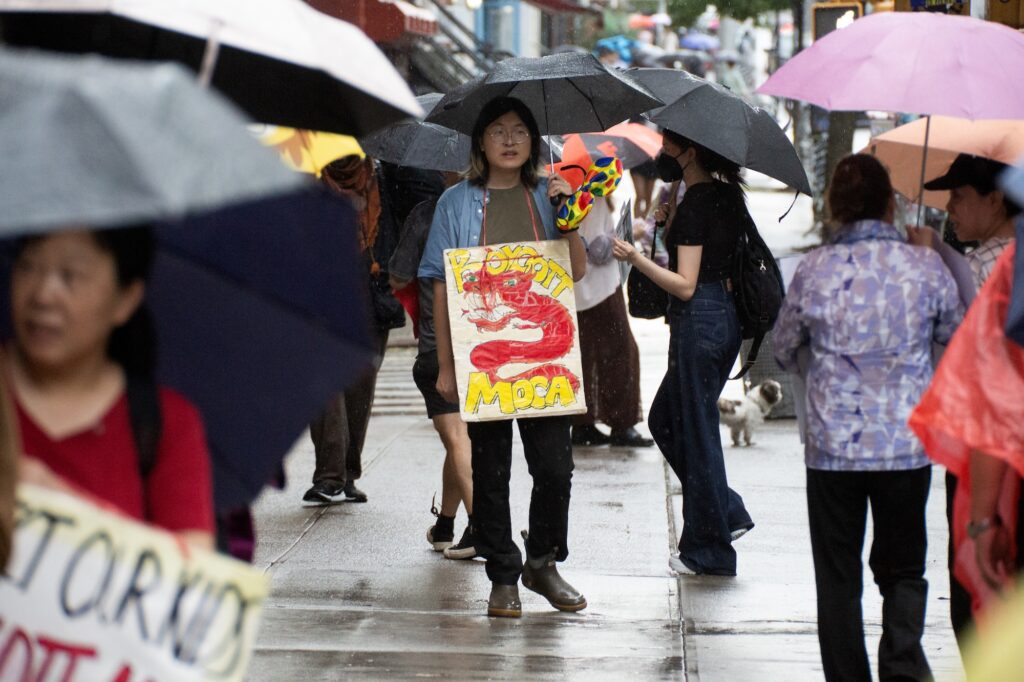

In 2019, New York City provided $35 million in capital funding to the Museum of Chinese in America as part of a community concession attached to funding for a new jail in Chinatown, leading to a group of activists led by Youth Against Displacement to picket MOCA for the last six years. Last Tuesday, the Museum of Chinese in America finally held a town hall to address the controversy, and Danielle Wu has posted a deeply detailed report at the Asian American Arts Alliance website that’s very much worth reading.
I attended the town hall as a photojournalist and community member and saw a tremendous amount of pain and distress from folks on both sides of this conflict. Some photos and thoughts…
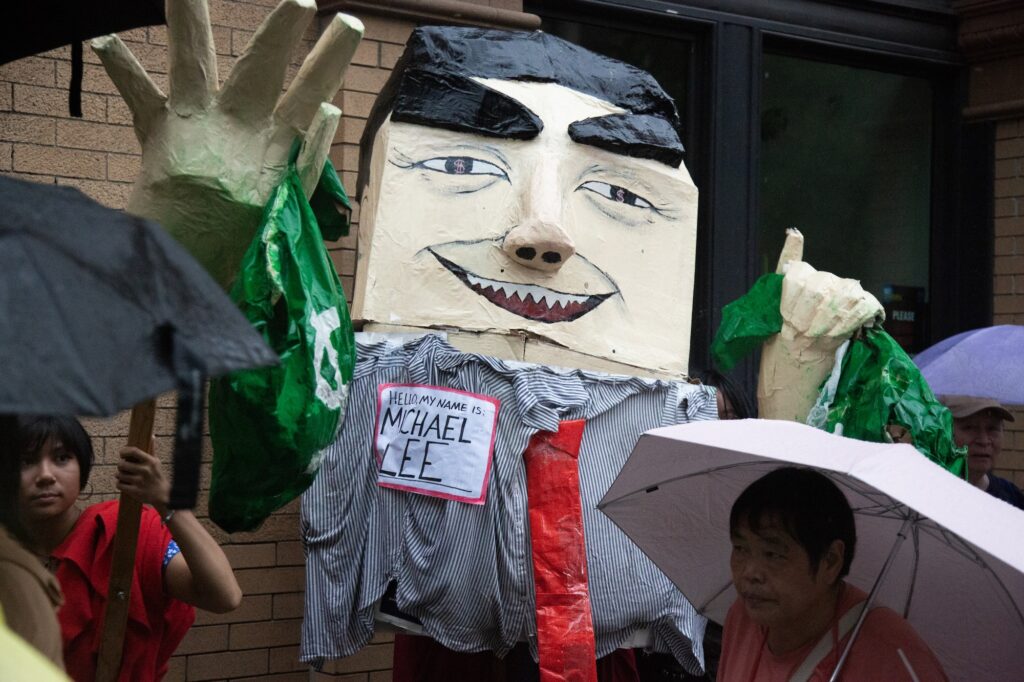
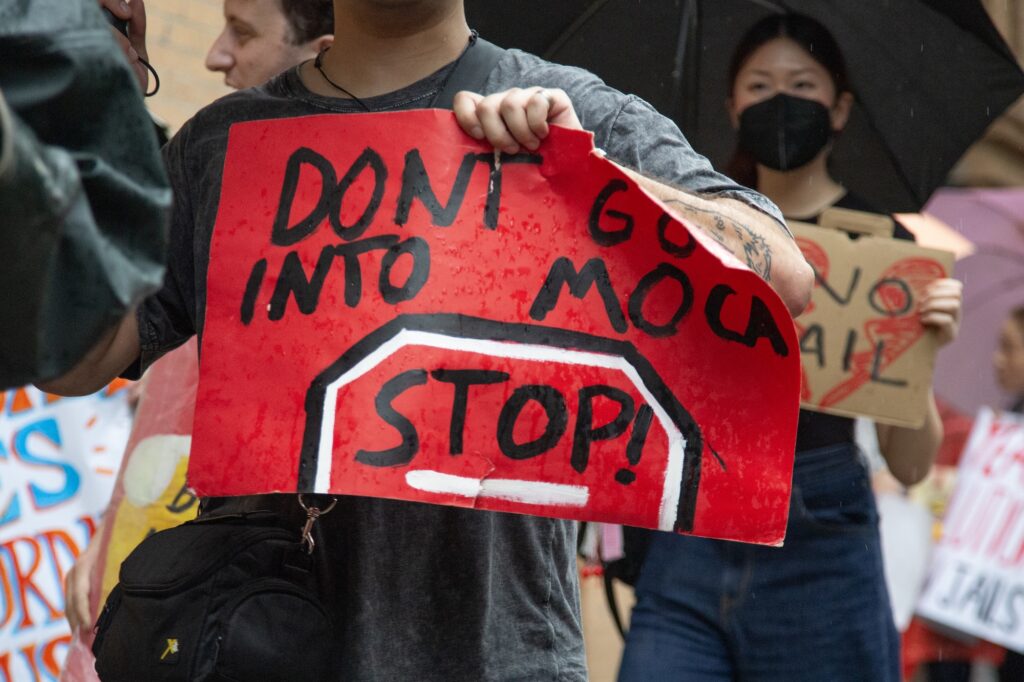
Protestors from Youth Against Displacement boycotted and picketed the MOCA town hall at the Manny Cantor Center on East Broadway. The big puppet is modeled on Michael Lee, President of MOCA. Youth Against Displacement members did not attend the town hall.
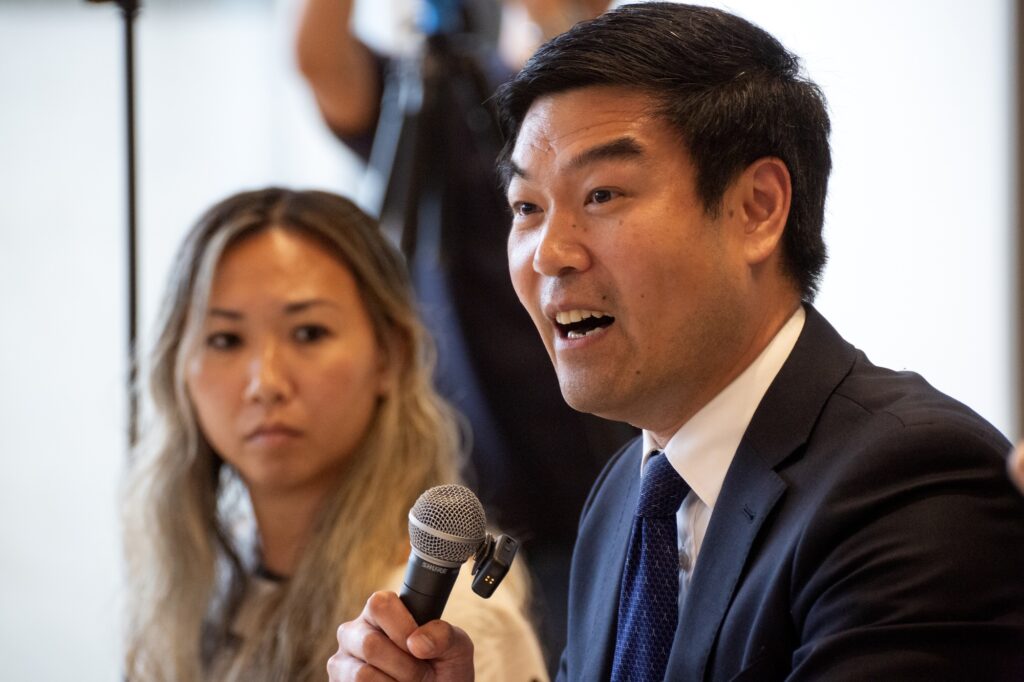
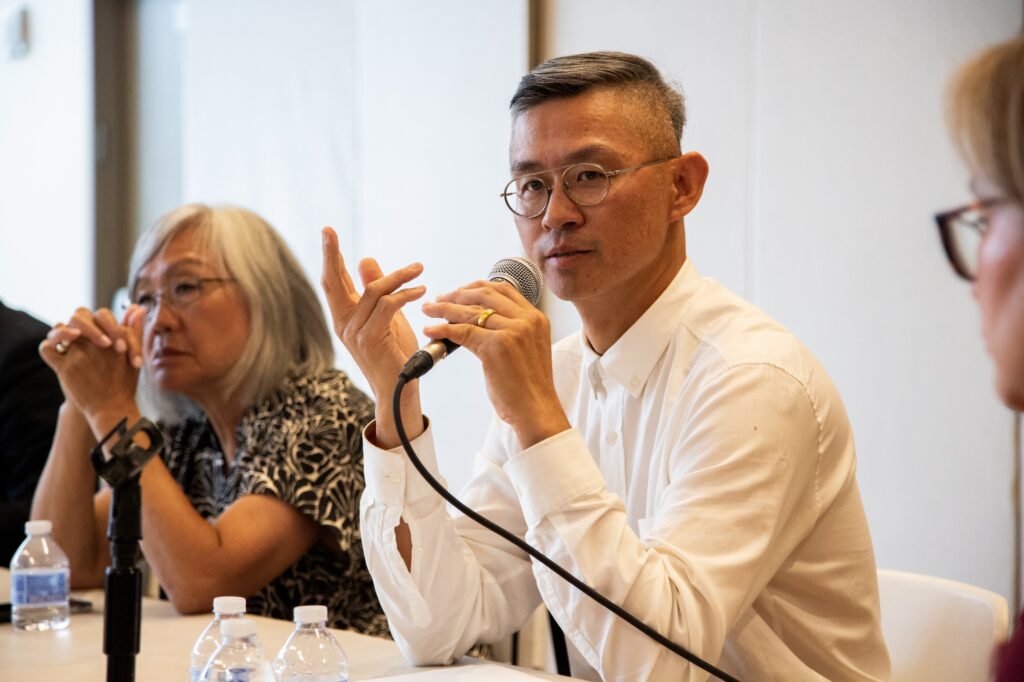
During the town hall, MOCA president Michael Lee (above left) said the museum has always been against the construction of the new jail and that it didn’t ask for its funding to be included as a community concession, but that if it hadn’t accepted the money, the museum would have had to close.
Both Lee and MOCA curator Herb Tam (above right) said they regret taking so long to hold a public town hall to speak to and hear from the community.
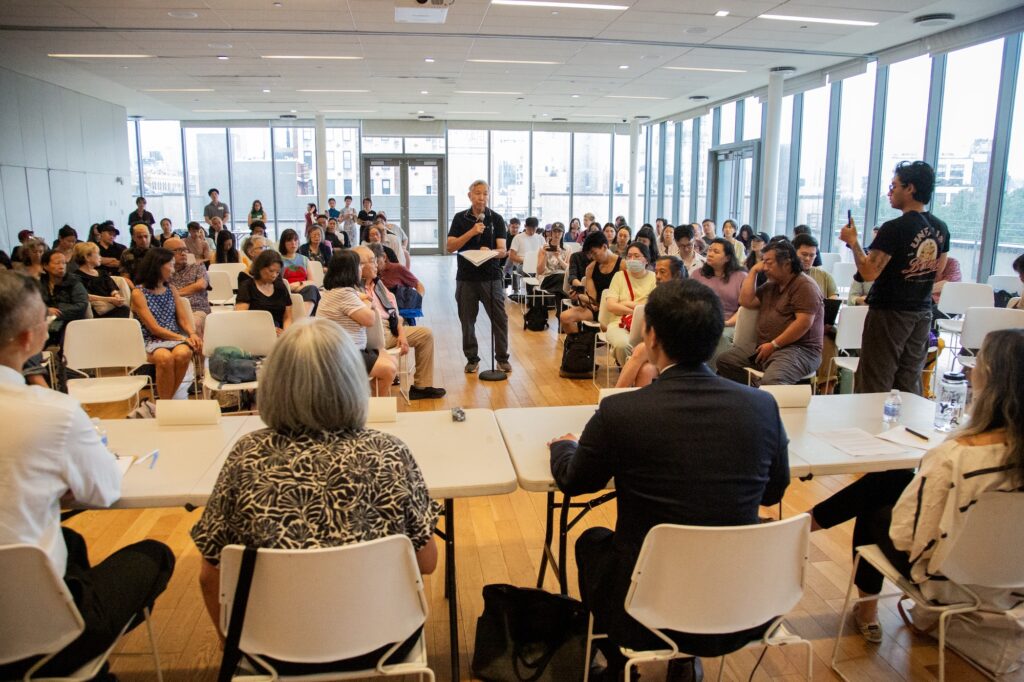
Given the rain and weather alerts, the town hall was very well attended. I’d describe the atmosphere as tense and solemn. Barely any chuckles from the crowd – everyone there seemed to feel the importance of the issue for the community. Rocky Chin, a supporter of the museum, was the first speaker. This quote from Danielle Wu’s article feels like a fair assessment of much of the discussion:
This generational divide seemed to continue throughout the evening. Chinatown veterans who lived through an era without a museum or other avenues to learn about Chinese diasporic identity beseeched audiences to not disregard how meaningful and laborious it was to even have MOCA. Karen Chun, whose father was on the board of Chinatown History Project as one of the initial people bringing in objects to MOCA, said, “Our history deserves to be honored and saved and taught. By destroying MOCA, we destroy our history. Who else is going to be recording it, and where else can our children learn from?”
A person whose picture I failed to take because I got so wrapped up in her testimony said she came to the event with great pain. Talked about sympathy with the protestors and distress over the jail money, but also talked about the deep importance of the museum.
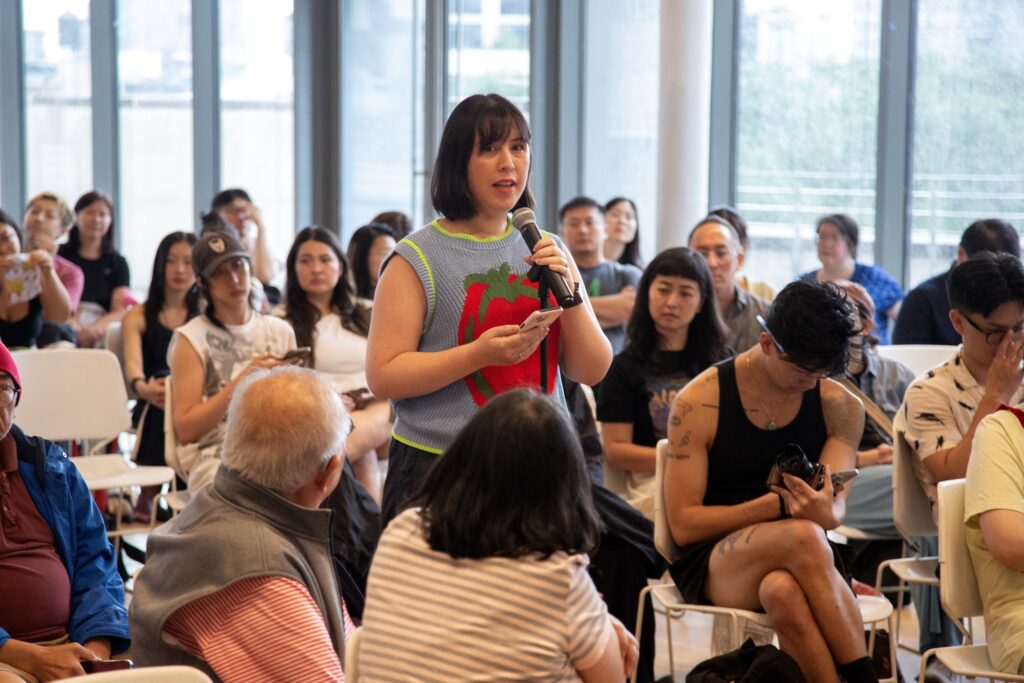
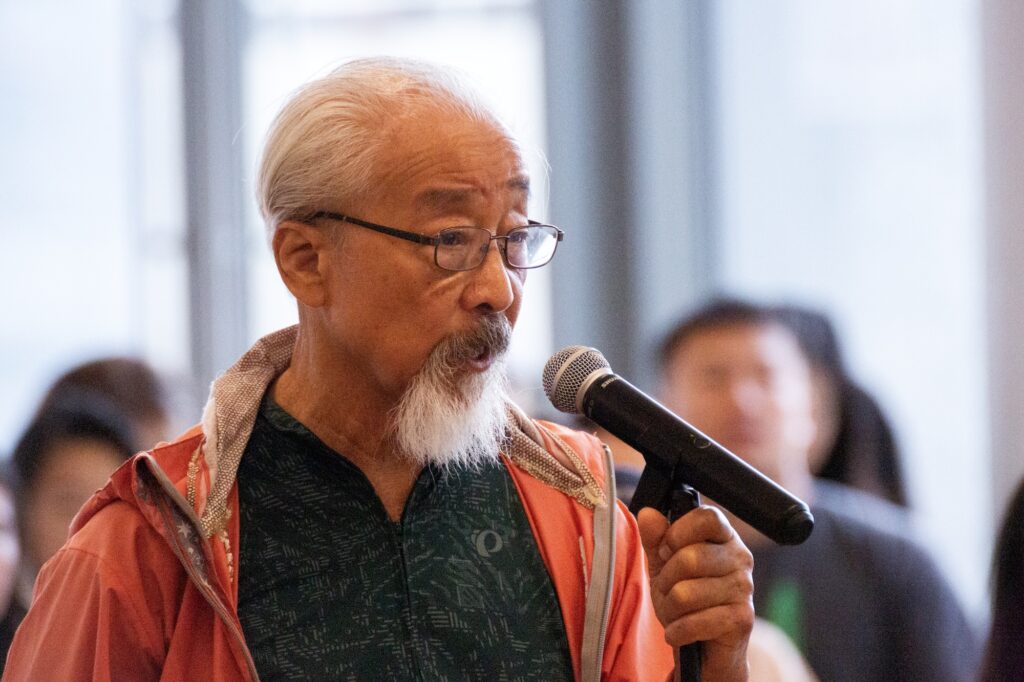
Katie Gee Salisbury and Robert Lee are pictured above. Danielle Wu’s report quotes Salibury as saying, “I think that MOCA deserves to exist.”
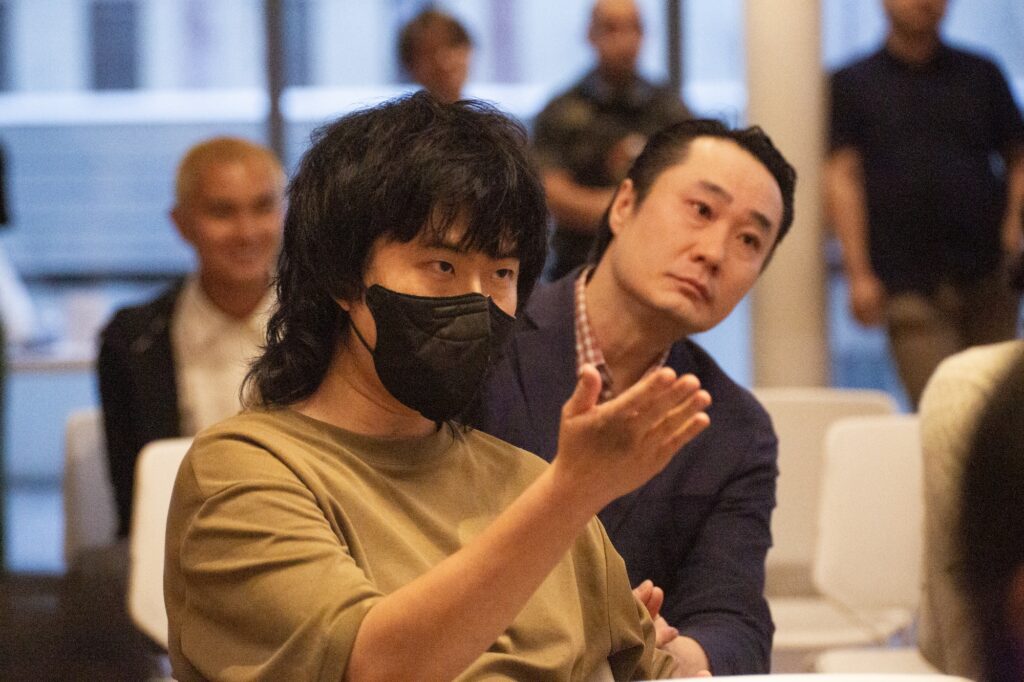
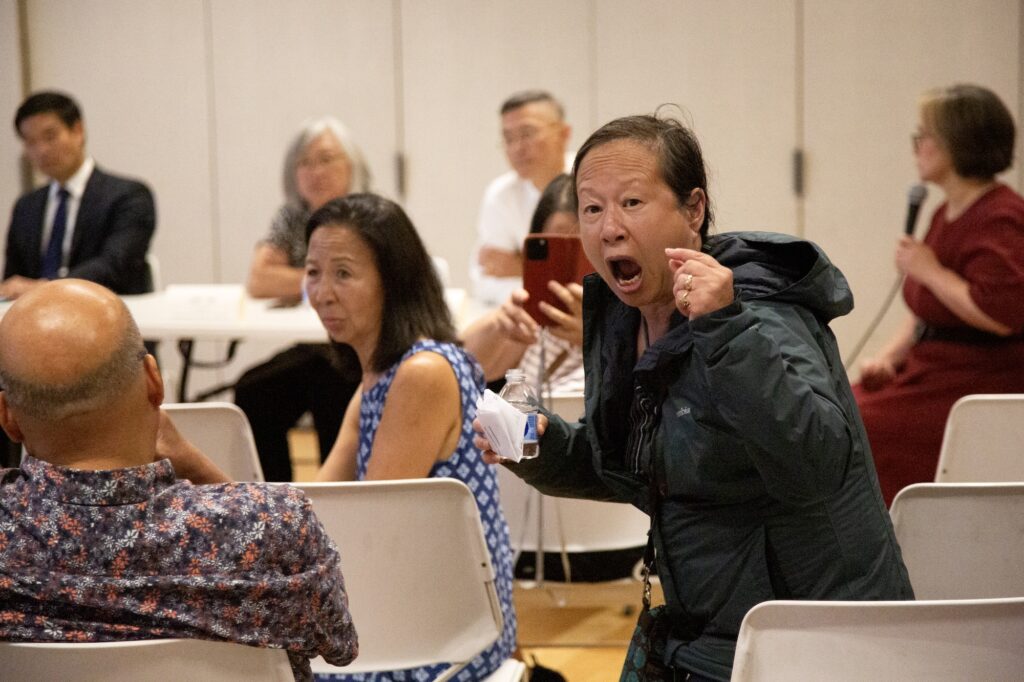
The most intense moment of the town hall came as Liz Ouyang responded to Aaron Yin’s demands that Michael Lee clearly state that the $35 million was jail money. Ouyang said that “jail money” is the city’s term, “not ours,” and that the city was intentionally dividing the community through these kinds of tactics. Earlier in the meeting, Ouyang said despite the manner of how it was given, the money was OWED to the museum – based on years of underfunding for the community from city, state, and federal government. Wu reports:
Liz Ouyang, a civil rights attorney, similarly shifted blame from the museum onto the city. Speaking about her personal experience as a fundraiser, she saw the community concession as a common practice whenever the government wanted to put “an unpopular building in a low-income neighborhood.” “To the city, this was jail money,” she said. “What’s missing in this whole conversation is the history of Asian American organizations not getting federal, state, and local city money.” And she’s right: according to the Coalition for Asian American Children and Families, AAPI nonprofit groups receive less than 5% of New York City’s grant funding, despite Asian New Yorkers making up nearly 18% of the city. Statistics at a national level are even more tragic. According to Asian Americans / Pacific Islanders in Philanthropy, just 0.34% of US philanthropic dollars reach AANHPI communities. That’s 34 cents out of every $100 awarded by US funders.
One of the demands of Youth Against Displacement has been for the museum to “return the $35 million they got for the jail to the community” (ref). But a community member at the town hall and MOCA officials noted that the $35 million was capital funding, earmarked by law for museum construction.
Lee made a number of pledges for what the museum WOULD do moving forward. The museum sent those pledges in a follow up email the next day:
- Convene a Chinatown Council — We will establish a standing community advisory body to provide ongoing input into our future growth as we work toward becoming the nation’s leading institution dedicated to Chinese American art, history, and culture.
- Champion Chinatown’s small businesses — We will continue documenting the stories of the families behind the neighborhood’s restaurants and shops, feature them as vendors at our events, and encourage our visitors to support local businesses throughout Chinatown.
- Teach Chinese American history in neighborhood schools — We will continue partnering with local schools, including PS 124, to teach Chinese American history, support educators, and showcase students’ work in our galleries so these stories continue across generations.
- Help families preserve their own histories — We will continue offering free preservation workshops and digitization days with professional conservators so that families can safeguard their histories for future generations, just as we fought to preserve our own collection after the fire at 70 Mulberry Street.
- Support local artists — We will continue providing dedicated space and opportunities for artists across disciplines through an open-call process, ensuring that new voices and creative work remain at the heart of MOCA.
Lee also said that a new event space at the museum would be used for programming for the community.
There are MANY more nuances to the conflict involving a former MOCA board member and Chinatown landlord named Jonathan Chu, the closing of the Jin Fong restaurant, Lee’s position on the Chinese Planning Council’s board, and movement to end the 24 hour work day.
Full disclosure: I’ve had a lot of attachment and love for MOCA over the years. I was one of the organizers of the Asian American Comic Con that was MOCA’s very first event in 2009, and I’ve both attended and had my work featured in multiple MOCA events and exhibitions over the years. I’m Korean American, not Chinese American. But the museum has always felt like a vital home for Asian American history to me. So I want MOCA to endure and thrive. But I also want it to do right by the immediate and wider community.
I share the distress of many of the community members who spoke at the event — it feels like a genuine rift in the community, amplified by the fact that it’s happening at the same time as the Asian American Writers’ Workshop’s ongoing failure to make good with its union.
I don’t pretend to have any magic answers. But I found myself thinking about parallels with universities and other institutions whose history is tied to slavery.
Regardless of whether you think accepting the community concession grant was necessary or justified, I think it’s fair to say that by taking money associated with the jail, MOCA now has a much larger responsibility to the community, which it seems to be starting to acknowledge. At the same time, as far as I can tell, it doesn’t seem that MOCA actually has the power to meet the main two YAD demands – reopening the Jing Fong restaurant and turning over capital funding the museum cannot legally redirect. But I absolutely think the museum can do much more to work with and generate support and aid and money for the community – including and beyond the museum’s five pledges listed above.
I’m glad the town hall took place and I hope it’s cracked the door and can lead to real discussion and partnership.